
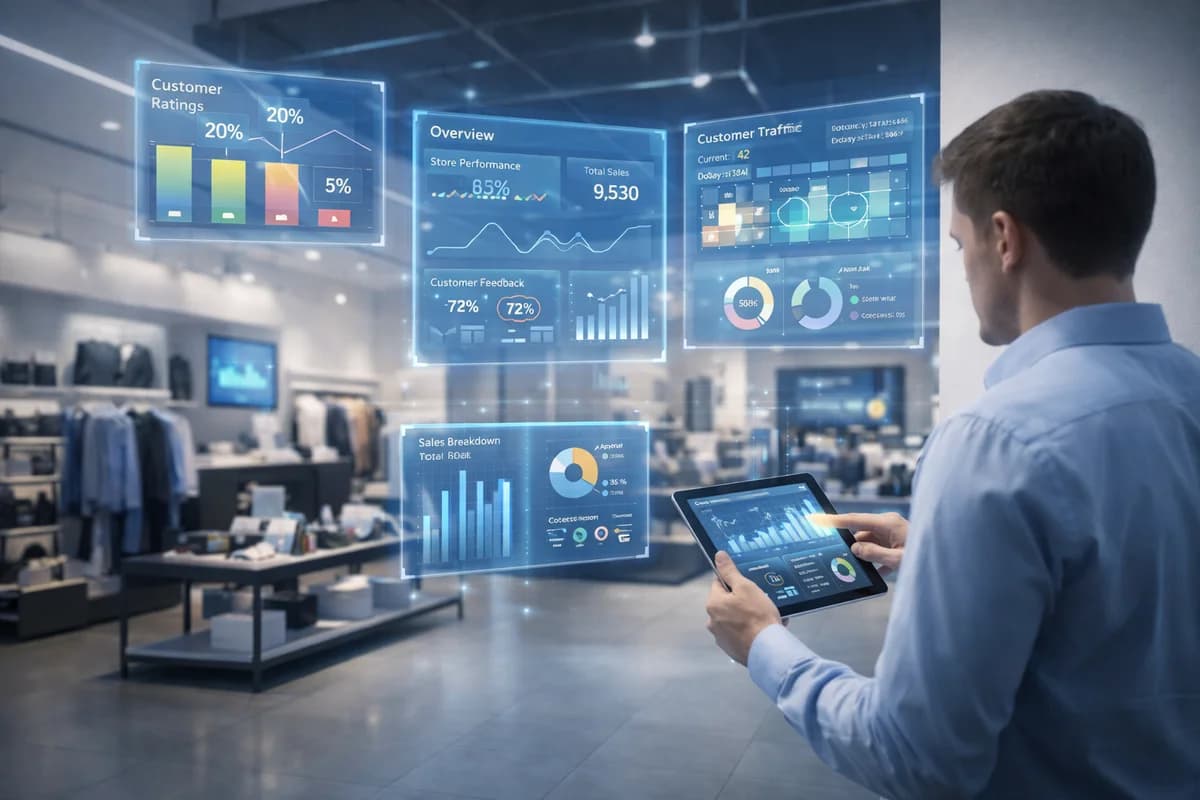
Retail is no longer just about shelves, staff, and checkout counters.
Modern stores are becoming intelligent systems — where physical spaces are connected to digital infrastructure in real time.
This transformation is powered by one core technology:
The Internet of Things (IoT).
At SmileSense, IoT is not a buzzword. It is the foundation that connects the physical store to the cloud — turning simple button presses into live business intelligence.
The Problem with Traditional Retail Data
Most retail data is delayed.
Sales reports, surveys, and analytics dashboards typically show what happened hours, days, or weeks later.
By the time managers see a problem:
- The customers are already gone
- The experience cannot be corrected
- The damage may already be public
This is the core limitation of legacy retail systems.
They describe the past — but cannot influence the present.
IoT changes this completely.
What IoT Really Means for Retail
IoT (Internet of Things) refers to physical devices equipped with:
- Sensors
- Connectivity
- Embedded software
These devices collect data and transmit it instantly to cloud platforms.
In retail, IoT transforms physical actions into live digital signals:
| Physical World | Digital World |
|---|---|
| Button pressed | Cloud event |
| Customer reaction | Data stream |
| Store activity | Live dashboard update |
This is how the physical store becomes part of the digital ecosystem.
From Button to Dashboard in Milliseconds
Let's break down what happens when a customer presses a SmileSense button.
This is not a simple counter — it is a distributed real-time system.
Step 1: Physical Interaction
A customer presses a physical button at the exit point.
This action is captured by the device's microcontroller.
Step 2: Edge Processing
Inside every SmileSense device is a Wi-Fi-enabled embedded system.
It immediately:
- Reads the button signal
- Adds metadata (device ID, store ID, timestamp)
- Packages the event securely
This happens in milliseconds.
Step 3: Secure Cloud Transmission
The device sends the event over an encrypted HTTPS connection to the SmileSense cloud API.
This eliminates:
- Manual uploads
- Batch syncing
- Local storage delays
Each interaction is transmitted in real time.
Step 4: Cloud Processing
The SmileSense backend instantly:
- Validates the device
- Stores the event in the database
- Updates analytics pipelines
- Triggers dashboards and alerts
This all occurs automatically — no human involvement required.
Step 5: Live Dashboard Update
Within fractions of a second:
- The store's dashboard updates
- Trends adjust
- Alerts may trigger
A physical action in the store becomes a live data point in the cloud.
This is the essence of IoT in retail.
Why Wi-Fi-Connected Devices Are a Game Changer
Traditional hardware systems rely on:
- Manual data collection
- USB downloads
- Periodic syncs
- Local storage
These models are fragile and slow.
Wi-Fi-enabled IoT devices provide:
| Benefit | Business Impact |
|---|---|
| Real-time data | Immediate visibility |
| Remote management | No on-site maintenance |
| Continuous uptime | Always-on intelligence |
| Scalable deployment | Thousands of devices, one platform |
This turns physical hardware into a living digital network.
Edge + Cloud = Retail Intelligence
The real power of IoT comes from the combination of:
- Edge computing (processing inside the device)
- Cloud computing (central intelligence)
SmileSense devices act as intelligent sensors at the edge, while the cloud provides:
- Aggregation
- Analytics
- Visualization
- Long-term insights
This architecture allows the system to scale from one store to thousands — without changing the model.
Why This Matters for Store Owners
Real-time IoT infrastructure enables:
- Live performance monitoring
- Instant problem detection
- Location-based analytics
- Historical trend analysis
- Multi-store intelligence
Instead of guessing what is happening inside stores, owners gain live operational awareness.
The store becomes observable — like a modern IT system.
The Physical Store Becomes a Data Source
E-commerce has always been data-rich.
Physical retail historically has been data-poor.
IoT closes this gap.
With connected devices:
- The store generates live behavioral data
- Physical experience becomes measurable
- Offline retail gains digital intelligence
This is the foundation of smart retail.
Reliability Through Engineering
For IoT to work in real business environments, hardware must be:
- Stable
- Secure
- Always connected
- Remotely manageable
SmileSense devices are engineered as infrastructure, not gadgets.
They operate continuously, update remotely, and integrate seamlessly into cloud systems — just like professional enterprise hardware.
This is how physical devices become trusted components of digital operations.
The Future: Autonomous Retail Systems
As IoT networks expand, physical stores evolve into self-monitoring environments:
- Real-time experience tracking
- Automated alerts
- Data-driven optimization
The boundary between physical and digital disappears.
Retail becomes a connected system — not just a location.
Final Thought
IoT is not about devices.
It is about visibility.
By connecting physical stores to the cloud, IoT transforms invisible experiences into measurable intelligence.
SmileSense sits at this intersection — where hardware meets data, and physical interaction becomes digital insight.
That is the future of retail.
And it is already here.